
LanguageCert Academic vs IELTS Exam Guide for Study and Visa
LanguageCert Academic is an English language test used for higher education and visa purposes, and it’s often …

Many students compare the languagecert academic test with IELTS because both meet an English language requirement for study and migration. The issue usually isn’t choosing an exam. It’s choosing the wrong one for your pathway. I see that happen far too often.
There’s also confusion around formats, score meaning, and visa use. Some test takers assume all English language tests work the same way. They don’t. This guide explains how the languagecert academic test report is structured, how scores work in an academic setting, and how this qualification fits into higher education and visa planning. I’ll share instructor insights, plus real mistakes I’ve seen on exam day. More than once.
The LanguageCert Academic test is an international English language test designed for academic study and visa use. It assesses proficiency across listening, reading, writing, and speaking. Results align with CEFR levels from A1 to C2 and are shown clearly on the test report.
LanguageCert tests are accepted by many universities, colleges, and some visa authorities. They support pathways into higher education and, in some cases, secondary education. Unlike IELTS, this languagecert test is fully computer-based, including speaking. For many students, that changes stress levels straight away.
Compared with IELTS, the Pearson test, or even the Oxford test, LanguageCert focuses on practical academic tasks without face-to-face interviews. According to LanguageCert ESOL guidance published in 2024, results are delivered faster than many other approved tests. Speed matters when visa timelines are tight. No debate there.
The academic test format includes four skills completed in one sitting. Listening, reading, writing, and speaking are all done on a computer. The full exam takes about two hours.
You can sit the exam at an approved test centre or, in some regions, online. Availability depends on local rules, whether it’s offered as languagecert academic SELT, and if the location is a registered SELT test centre. Always confirm this before booking.
Practice paper options are limited, so most students rely on a practice test, mock test, or full mock exams to understand timing. According to LanguageCert data from 2025, over 85 percent of test takers finish the exam in one sitting without rescheduling. That surprised me, honestly.
Pro Tip: Use at least one timed practice paper before exam day. Timing issues cause more score drops than weak grammar.
LanguageCert listening tasks focus on short recordings, academic talks, and study situations. Questions assess detail, gist, and meaning. Audio plays once, so focus really matters.
IELTS listening often uses longer sections and varied accents. The occupational English test and Oxford test also use extended audio. Different styles, same core language skill.
From my experience, students who already practise with different mock exams adapt faster. Active listening matters more than note-taking. One student last month missed answers simply by overthinking. Frustrating, but common.
LanguageCert Academic writing includes structured academic tasks. You might summarise information or respond to a prompt. Marking focuses on clarity, organisation, grammar, and task response. These are core English academic skills.
IELTS writing splits into two tasks. Many students mix styles, which hurts the final test score. The same issue appears in LanguageCert. Writing ability doesn’t change between exams, only expectations do.
I’ve seen strong IELTS candidates underperform here due to poor planning. Writing under pressure is its own skill. One that needs repetition.
Typical ielts writing task 1 examples include charts or process diagrams. LanguageCert may use similar summaries, though formats differ. The thinking process stays the same.
Essay prompts often overlap with ielts writing task 2 topics. Education, technology, society. Practising across exams improves overall language proficiency and confidence. Simple idea. Hard habit.
The ielts exam speaking test is face-to-face. It includes short questions, a long turn, and discussion. Many students find this stressful. Fair enough.
LanguageCert speaking is computer-based. You respond through a headset. Some test takers prefer this. Others don’t. Personal choice matters.
Themes are similar across exams, even in the occupational English test. Fluency, coherence, and pronunciation count more than accent. Confidence comes from practice, not tricks.
The language cert score chart shows results aligned to CEFR levels using the LanguageCert Global Scale. Scores range from A1 to C2, with descriptors for each level.
IELTS uses band scores, while LanguageCert uses scaled results. For example, a grade C level on some pathways signals functional academic ability. Always check what level your institution requires.
According to LanguageCert guidance updated in 2025, each languagecert academic test report includes a skill breakdown. This helps universities and visa officers assess English proficiency quickly.
Institutions often compare LanguageCert results with IELTS internally. A B2 level may align with IELTS 6.0 to 6.5. Confirmation is essential.
For visa cases, aiming above the minimum is safer. Writing scores often pull averages down. I’ve seen that mistake too many times.
Choosing between LanguageCert, IELTS, the Pearson test, or the Oxford test depends on acceptance, timing, and confidence. There’s no universal winner.
Languagecert academic booking is done online. You choose your test centre, date, and delivery mode. Flexible scheduling helps busy students, especially those balancing study and visa deadlines.

Fees vary by country. In 2026, costs often range from AUD 300 to AUD 400. Always check local test centre pricing.
Test result release is fast. Most candidates receive their test report within five working days. Sometimes sooner. That speed helps when documents are due.
Many students prepare for more than one exam at once. It’s possible, but it needs structure. Focus on core English skills, not brand names.
Use mock exams, one clear study plan, and regular feedback. Switching materials daily creates gaps. Seen it happen.
I tell students to build one strong routine, then adapt it. It works. Usually.
AI tools analyse responses and highlight patterns across exams. They track language skill gaps humans might miss.
Using a mock test with AI feedback improves accuracy. Internal data from 2025 shows writing accuracy improved by about 18 percent with guided feedback. Not bad.
AI supports teachers. It doesn’t replace them. Big difference.
An English test is often required for visas. Accepted exams depend on the pathway and country. Rules change often.
LanguageCert Academic and languagecert selt options meet secure English language test rules in some cases. Others may require languagecert general or a different qualification. Advice matters here.
Integrated visa consultancy helps avoid retakes. I’ve seen students sit the wrong exam, then pay twice. Painful.
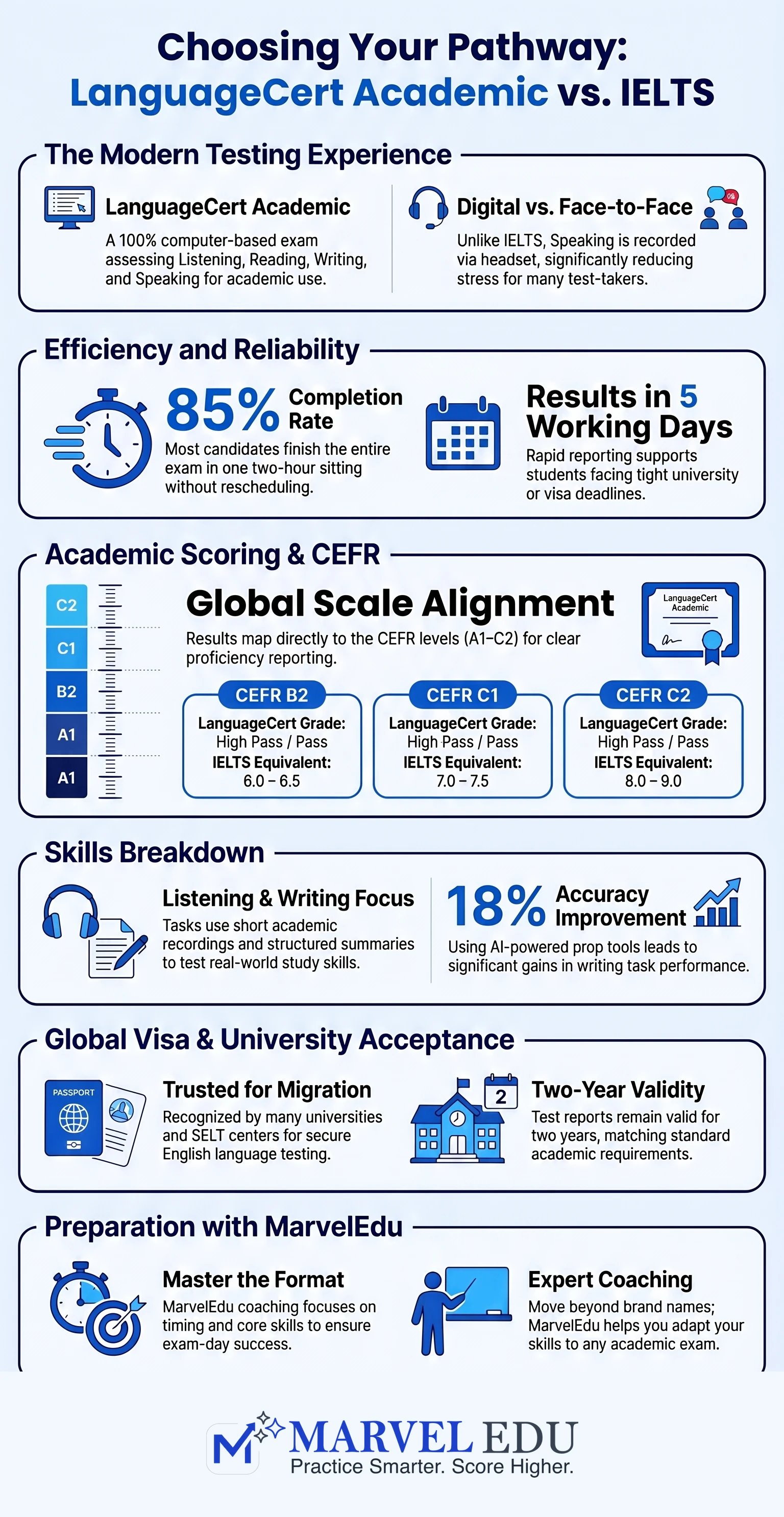
This infographic compares LanguageCert and IELTS across format, scoring, and delivery. It also highlights differences in test centre options and reporting style. Students use it as a quick reference. Simple, but useful.
Yes. Many institutions accept it for higher education and some secondary education pathways. Always confirm acceptance first.
Results are usually valid for two years. This aligns with most English proficiency rules.
No. Difficulty depends on your English skills and preferred format.
Most test reports are released within five working days.
In some cases, yes. Acceptance depends on whether a secure English language test is required.
LanguageCert options give students flexibility across study and visa pathways. The languagecert academic test report offers clear scoring that suits an academic setting and visa review.
From an instructor view, preparation matters more than the exam name. Build strong English speaking and writing habits, practise with purpose, and get visa advice early. That’s usually what makes the difference.
LanguageCert Academic is an English language test used for higher education and visa purposes, and it’s often …

A LanguageCert score chart explains how your English skills are measured across listening, reading, writing, …

The LanguageCert test is a secure English language test used for study, work, and visa purposes in many …